
Milžinas Didvyris Šventasis
Historical and community context
Where this record belongs
Diaspora freedom
Introduction
A rigorous Catholic philosophical work written in Lithuanian by Dr. Pr. Gaidamavičius, published by the Lithuanian Franciscan Fathers in Brooklyn in 1954 with full imprimatur, exploring the three archetypes of human value fulfillment — the Giant, the Hero, and the Saint — as a framework for integral human perfection. The book's subtitle 'Žmogiškosios Pilnaties Vizija' (A Vision of Human Fullness) signals its ambition as diaspora philosophical theology. Uniquely, it includes English and French summary pages, indicating the Franciscans' intent to bridge Lithuanian intellectual culture with the broader international Catholic world at the height of the Cold War diaspora.
Context and significance
Significance
This publication is a landmark artifact of Lithuanian diaspora intellectual culture at its most self-assured and institutionally capable. The Franciscan Fathers' press in Brooklyn was one of the most productive Lithuanian-language publishing operations in the postwar diaspora, and this volume demonstrates that the community was sustaining not merely devotional or practical literature but ambitious original philosophical theology in Lithuanian — a language then suppressed and distorted inside Soviet-occupied Lithuania. The three-part structure (Giant / Hero / Saint) reflects the influence of personalist Catholic philosophy circulating in European and Latin American Catholic intellectual circles of the period, suggesting Gaidamavičius was engaged with international currents of thought while writing entirely in Lithuanian for a diaspora audience.
The inclusion of English and French summaries at the front of the book reveals a deliberate bilingual/trilingual communication strategy: the Franciscans wished to introduce Lithuanian philosophical output to the broader anglophone and francophone Catholic world, implicitly asserting that Lithuanian culture had intellectual contributions to offer the universal Church even in exile. This is a remarkable act of cultural confidence in the early 1950s, when the Lithuanian diaspora was still consolidating its institutional infrastructure. The imprimatur from the Diocese of Brooklyn and the Nihil Obstat from a Lithuanian censor deputatus show that formal ecclesiastical channels were fully operational within the diaspora community.
The cover artwork by V. K. Jonynas — one of the most celebrated Lithuanian diaspora artists, whose work hangs in the UN building — places this volume at the intersection of literary, theological, and fine arts production within the diaspora. The colophon datum placing the author's preface in Gracefield, Quebec, Canada in May 1953 suggests that the Lithuanian diaspora intellectual network spanned North America, with authors in Canada, publishers in Brooklyn, and printers in the same Franciscan press. This cross-border production model is itself a significant artifact of diaspora institutional culture.
How this record carried memory
Religion as language vessel, Faith framed as heritage, Identity preservation
Record connections
People, places, and institutions linked in the catalog
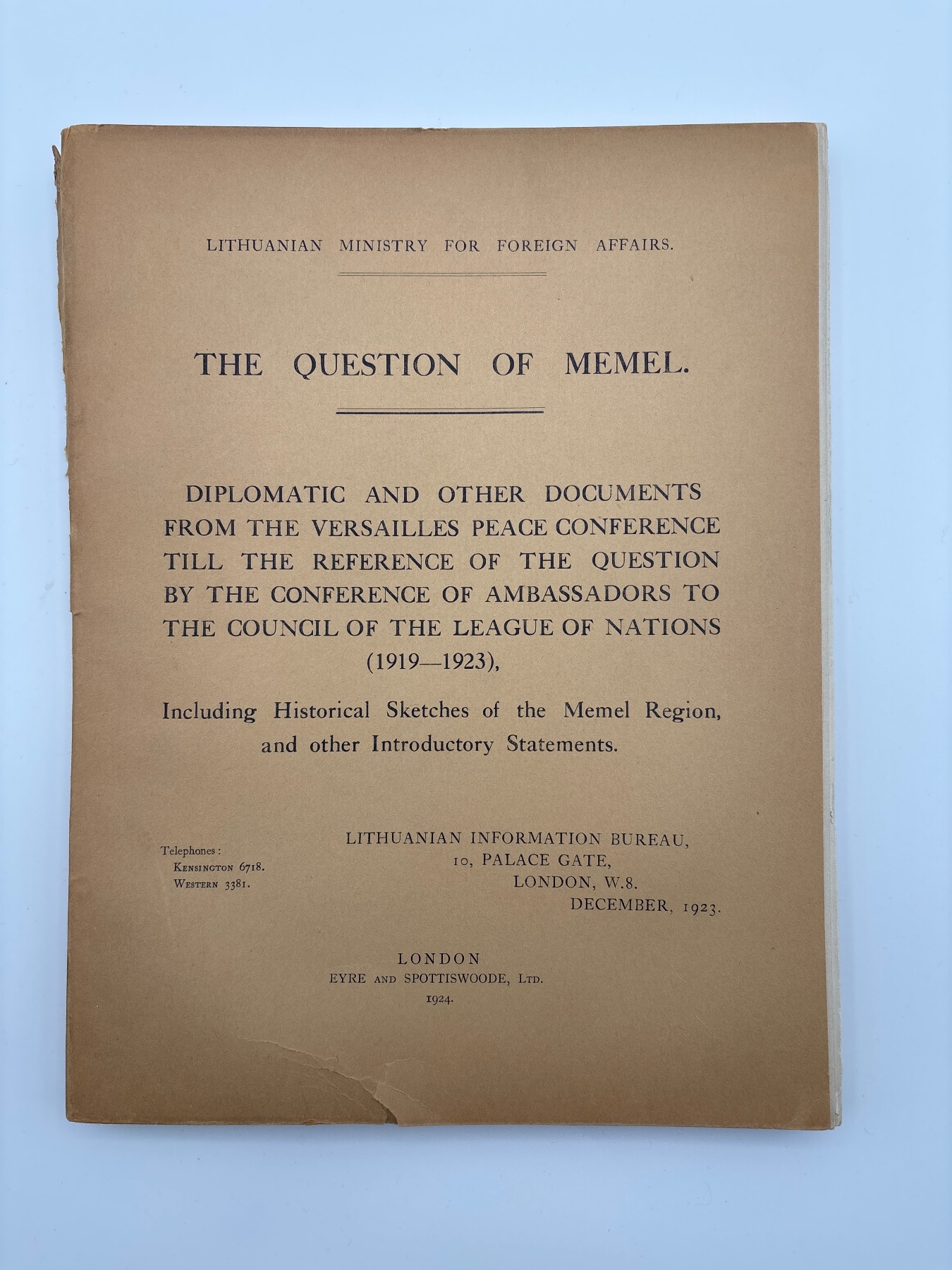
The Question of Memel: Diplomatic and Other Documents from the Versailles Peace Conference till the Reference of the Question by the Conference of Ambassadors to the Council of the League of Nations (1919-1923), Including Historical Sketches of the Memel Region, and other Introductory Statements

Lithuanian Writers in the West: An Anthology

Ateitininkų Ideologija