
METHODOLOGY
How an archive record is made
From a physical book and source photographs to a reviewed public catalog record
The Žiburio Archive holds thousands of Lithuanian diaspora materials accumulated over many decades. Much of the collection is still being sorted and cataloged. Fragile bindings, fading type, loose pages, inscriptions, stamps, and missing information all affect how each item must be handled and described.
The method is designed for careful documentation while remaining practical for high school students using mobile devices. Direct work with primary sources teaches students what a catalog record is built from and why physical details, provenance, and uncertainty matter.
The Process
Each intern selects a book from the sorted collection, opens it, and documents it through a sequence of approximately ten photographs submitted via a purpose-built mobile application. These photographs are not incidental illustrations — they constitute the primary documentary input from which the initial catalog proposal is derived.
The photographic protocol is structured to train the intern in systematic bibliographic observation. Each photograph targets a specific element of the book, and the sequence itself teaches the student where to look and what to notice:
Not every book contains all elements. A hymnal may lack a table of contents; a pamphlet may have no colophon. The intern learns to recognize what is present and what is absent — and both carry information. A missing copyright page in a 1948 DP camp publication tells its own story about the conditions of production.
This is not data entry. The protocol teaches a way of reading that most people — including adults — have never practiced: how to examine a book as a physical object with its own history. Where was it printed? Who approved it for publication? Whose handwriting is inside the cover? What does the paper quality reveal about the circumstances of its production? By the third or fourth book, interns begin noticing details unprompted — a library stamp from a DP camp, a hand-corrected erratum, a price written in occupation-era currency. The photographic protocol is the scaffold; the observational skill it cultivates is the lasting outcome.
No scanner is required. No workstation. A phone and a Saturday morning are sufficient to begin. Professional scanning enters the workflow at a later phase, when the project advances to archival-quality digitization with OCR full-text search. However, the structured catalog — the layer that renders materials findable, searchable, and interconnected — is built entirely from phone photographs.
The choice of the phone as the primary instrument is not a concession to limited resources — it is a pedagogical decision. The phone is the native medium of this generation. It is where they communicate, where they create, where they are most fluent. By placing a purpose-built application on a device they already carry, the project meets young people in the environment they inhabit and redirects the tool they know best toward materials they have never encountered. A leaderboard tracks contributions and surfaces competition. The interface speaks the language of the technology these students already use — and through it, they engage with materials printed decades before their parents were born. The newest technology applied to the oldest materials. That juxtaposition is the point.
Stabilization and Sorting
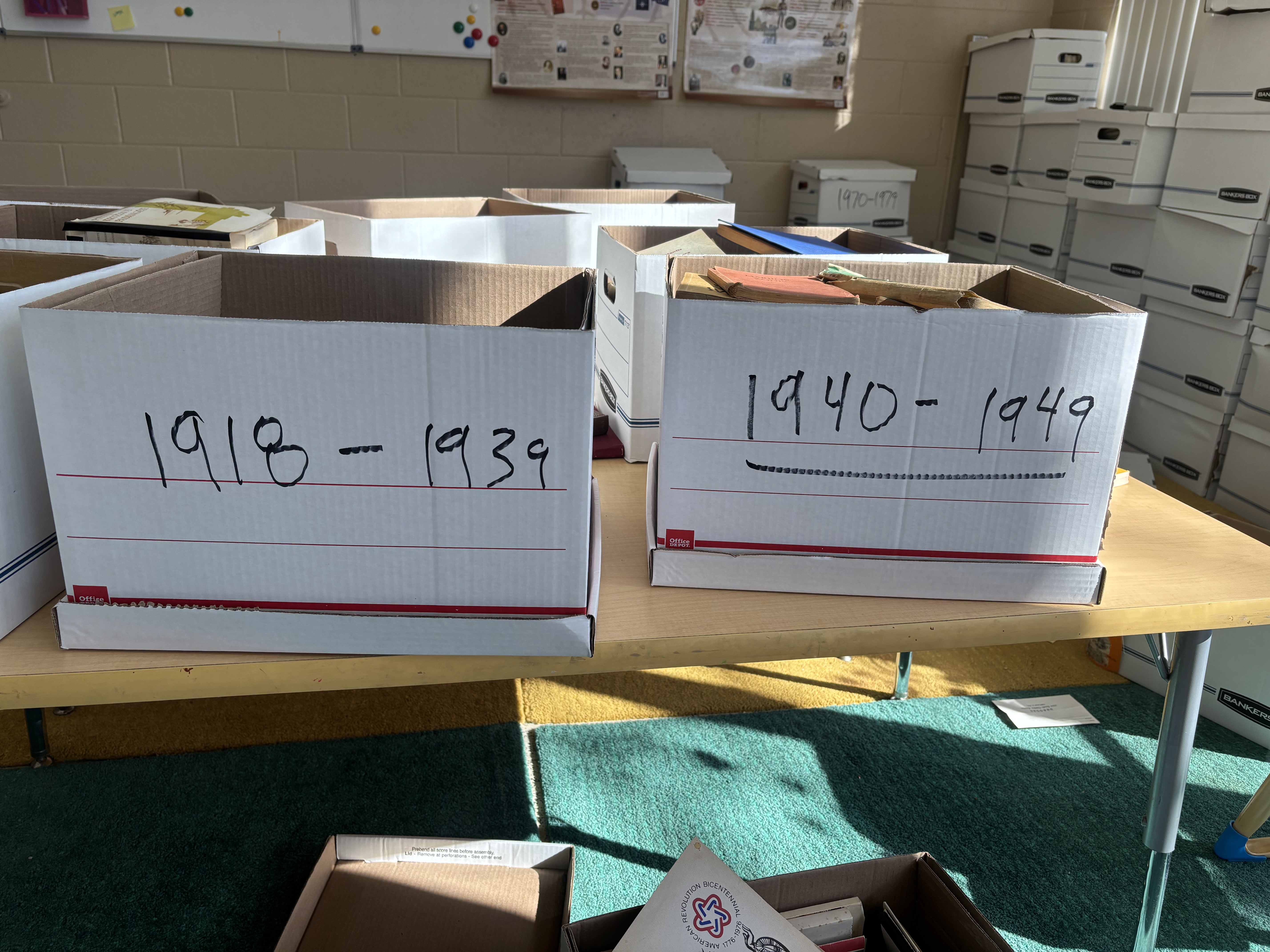
Prior to any cataloging, the collection requires physical stabilization. Many materials had been preserved for decades under informal conditions: stored in mixed containers, without chronological order or identification. Before documentation can proceed, the collection must be made physically legible.
Students in the Skaitmeniniai Knygnešiai program begin this work directly with the physical collection. Books are removed from storage containers and provisionally grouped by approximate date, place, and physical context. This initial order supports safe handling and systematic cataloging, while the final records preserve overlapping historical and migration contexts.
Structured Catalog Proposal
From the submitted photographs, the archive processing system extracts a structured metadata proposal in which each field carries a confidence score. It can propose a title, author, publisher, date, and other bibliographic details, but it does not finalize any field or publish a record. Its purpose is to shorten the interval between a photographed book and a catalog proposal ready for review.
The source photographs remain the basis for every proposal. Handwritten inscriptions, ownership stamps, dedications, imprimaturs, and older orthography are checked as material evidence of the book’s history, not treated as freely generated context.
Review and Publication
Every generated catalog proposal enters a review dashboard, where it is examined against the source photographs prior to publication. Key fields — title, date, material type, copyright status, and cultural context — are verified against the photographed source material. Nothing is published automatically. Human oversight is present at every stage of the workflow: the student photographs and submits, the system processes and proposes, and the archive curator verifies and publishes.
What a published record contains
A published record contains source-checked bibliographic details, copy-specific physical marks, provenance, selected photographs, and rights and access notes. Personal information stays private by default and is published only with explicit permission. If a date, authorship, or other detail is not established, the record carries an explicit unknown rather than a guess.
Discovery and Attribution
Students compare discoveries: the oldest volume, an unusual title, a previously undocumented press, or a handwritten note that changes what is known about a copy. The point is careful observation, not processing speed.
Student and contributor names, profiles, work statistics, and internal notes stay in the private working system. Public credit is included only after explicit permission and archive review.
Skaitmeniniai Knygnešiai students document the physical items and contribute observations grounded in source photographs. Archive reviewers retain responsibility for interpretation, privacy review, and publication.