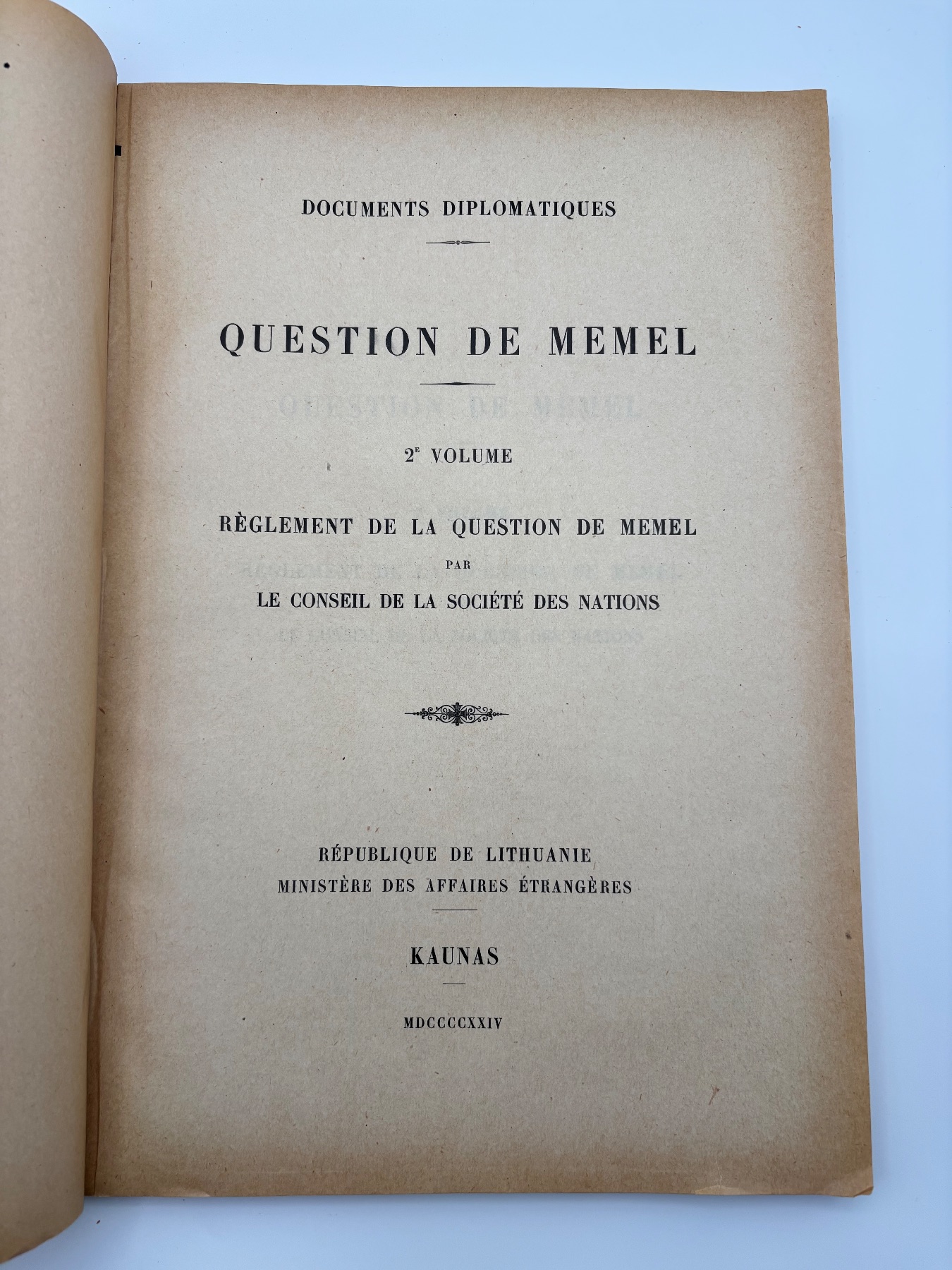
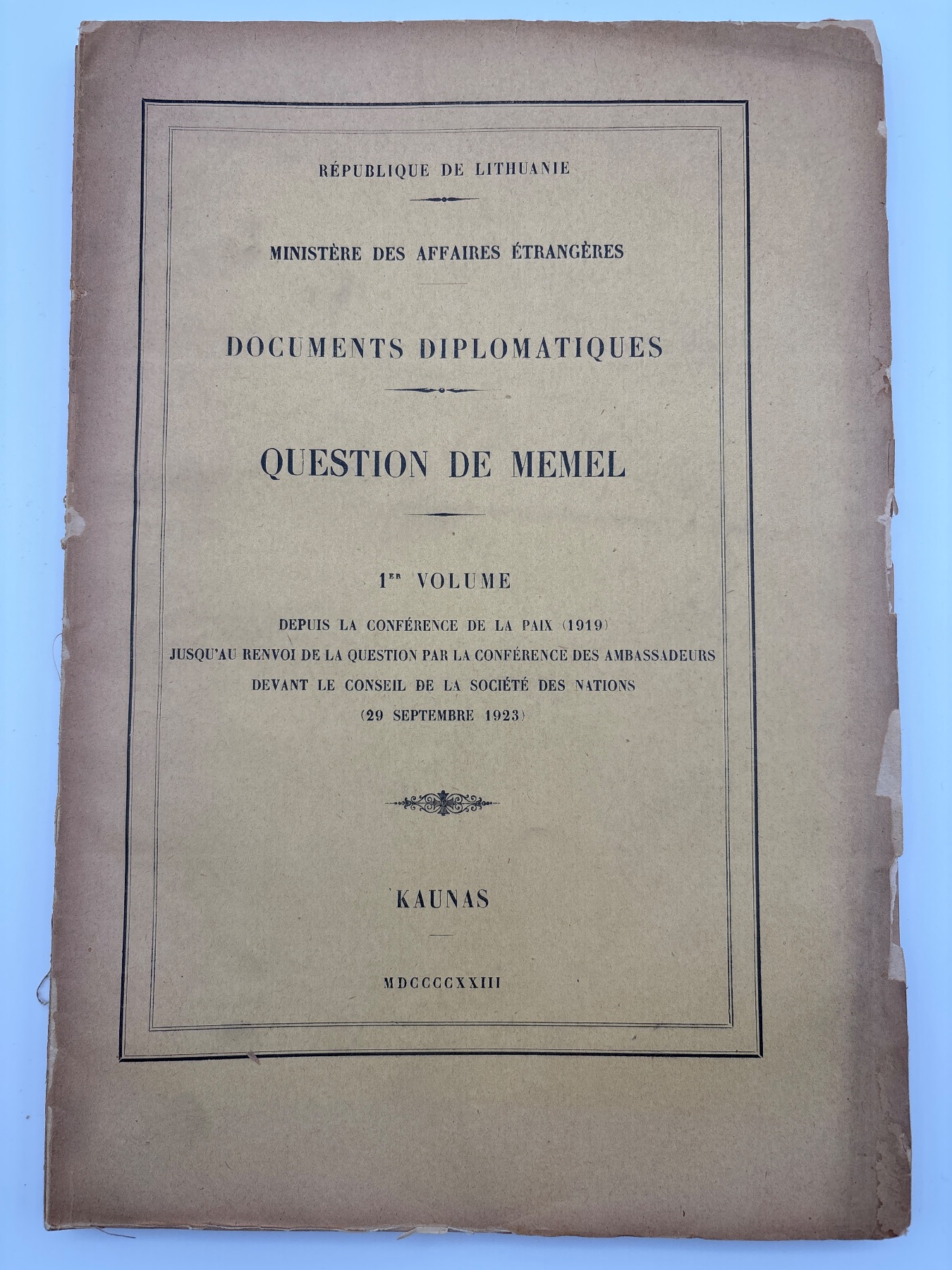
The Question of Memel: Diplomatic and Other Documents from the Versailles Peace Conference till the Reference of the Question by the Conference of Ambassadors to the Council of the League of Nations (1919-1923), Including Historical Sketches of the Memel Region, and other Introductory Statements
Historical and community context
Where this record belongs
Independent Lithuania
Introduction
This is a 1924 official diplomatic document collection published by the Lithuanian Ministry for Foreign Affairs, presenting nearly a hundred primary-source diplomatic exchanges, memoranda, and government declarations documenting Lithuania's successful campaign to annex the Memel Territory (Klaipėda) between 1919 and 1923. Published through the Lithuanian Information Bureau in London and printed by His Majesty's Printers (Eyre and Spottiswoode), this pamphlet represents a direct instrument of Lithuanian state diplomacy, designed to shape Allied and League of Nations opinion. It is among the rarest categories of early interwar Lithuanian state publication in the English language, making it an extraordinary window into both Lithuanian foreign policy strategy and the birth of the modern Lithuanian state.
Context and significance
Significance
This volume is a remarkable artifact of Lithuanian state-building in action: published just months after the January 1923 Memel Uprising and the subsequent transfer of the Memel Territory to Lithuanian sovereignty, it represents the newly independent Lithuanian government's deliberate effort to shape Western European and international opinion through carefully curated documentary evidence. The choice to publish in English, through a London bureau, printed by His Majesty's Printers, signals a sophisticated understanding of the diplomatic and media ecosystems of the early 1920s. The Lithuanian Information Bureau at 10 Palace Gate functioned as a proto-embassy public relations operation, and this volume is perhaps its most substantial surviving output.
The document collection itself constitutes a near-complete archival record of one of the most consequential territorial decisions in interwar Baltic history. The Memel Territory — the only ice-free port accessible to Lithuania — was critical to the country's economic survival and national identity. The inclusion of documents from Lithuanian community organizations within the Memel Territory (the Tautos Taryba, Chamber of Commerce, Peasants' Union, Lithuanian Youth organizations) alongside high-level diplomatic correspondence demonstrates a deliberate strategy of presenting the annexation as a grassroots popular movement rather than a unilateral military seizure. This layering of voices — from Lithuanian villagers to the Conference of Ambassadors — is itself a sophisticated act of narrative construction.
For diaspora communities, particularly those in Detroit and other North American Lithuanian centers, this document would have circulated as evidence of Lithuania's legitimate place among sovereign nations. Its existence in a school library collection suggests it may have been used to educate subsequent generations about the legal and historical foundations of Lithuanian statehood — a direct pedagogical link between the diplomatic battles of the 1920s and the cultural survival mission of Cold War-era diaspora institutions.
How this record carried memory
Continuity statement explicit, Identity preservation
Record connections
People, places, and institutions linked in the catalog