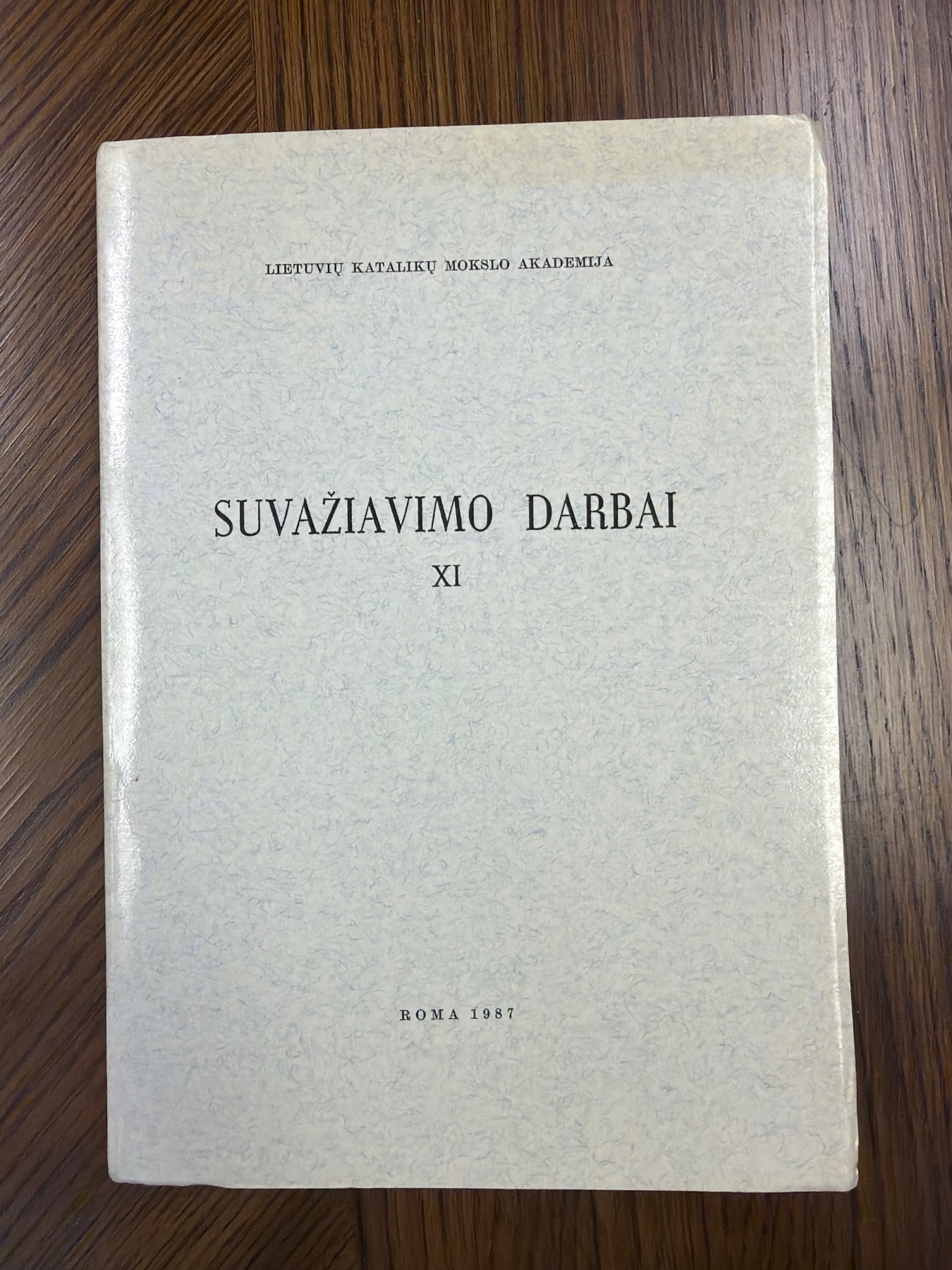
Suvažiavimo Darbai V / Istorinė Krikščionių Atsakomybė
Introduction
This volume is the fifth congress proceedings of the Lithuanian Catholic Academy of Sciences (Lietuvių Katalikų Mokslo Akademija), convened in Chicago in September 1961 and published in Rome in 1964 under the scholarly theme 'Istorinė Krikščionių Atsakomybė' (The Historical Responsibility of Christians). Edited by Jesuit scholar A. Liuima and printed at the Pontificia Università Gregoriana press, it gathers Lithuanian Catholic intellectual and clerical voices from the diaspora engaging questions of faith, science, and historical Christian witness. The volume represents a premier institutional expression of Lithuanian Catholic scholarly life in exile, with contributions acknowledged by Cardinal Pizzardo and correspondence from Bishop V. Brizgys as president of the Academy.
Community and publication context
Community and publication setting
Context and significance
Significance
The Lithuanian Catholic Academy of Sciences was among the most significant intellectual institutions of the Lithuanian diaspora, providing a space where scholars, clergy, and Catholic professionals could sustain rigorous academic inquiry in exile while Lithuania itself remained under Soviet occupation. This fifth congress volume, gathering papers delivered in Chicago in 1961 and published in Rome in 1964, represents a peak moment of diaspora institutional vitality: funded transatlantically, printed at one of the world's great Catholic universities, and endorsed by a Vatican cardinal. The congress theme—the historical responsibility of Christians—engaged directly with the moral and intellectual challenges of the Cold War moment, including the suppression of religion in Soviet Lithuania.
The volume is also a document of diaspora social organization. The funding acknowledgment to Kun. Juozapas Antanas Karalius of Shenandoah, Pennsylvania, and his designation as Honorary Member of the Academy reflects the dense networks of Lithuanian-American parish clergy who sustained scholarly and cultural institutions across the Atlantic. The presence of this volume in the Žiburio archive in Detroit attests to how these networks of institutional patronage and cultural exchange connected Lithuanian communities across North America to their Roman intellectual hub.
How this record carried memory
Institutional scholarly production by the Lithuanian Catholic Academy of Sciences in Roman exile; diaspora funding (Kun. Karalius, Shenandoah PA); congress convened in Chicago diaspora community; publication distributed through diaspora networks including Žiburio archive.
Record connections
People, places, and institutions linked in the catalog