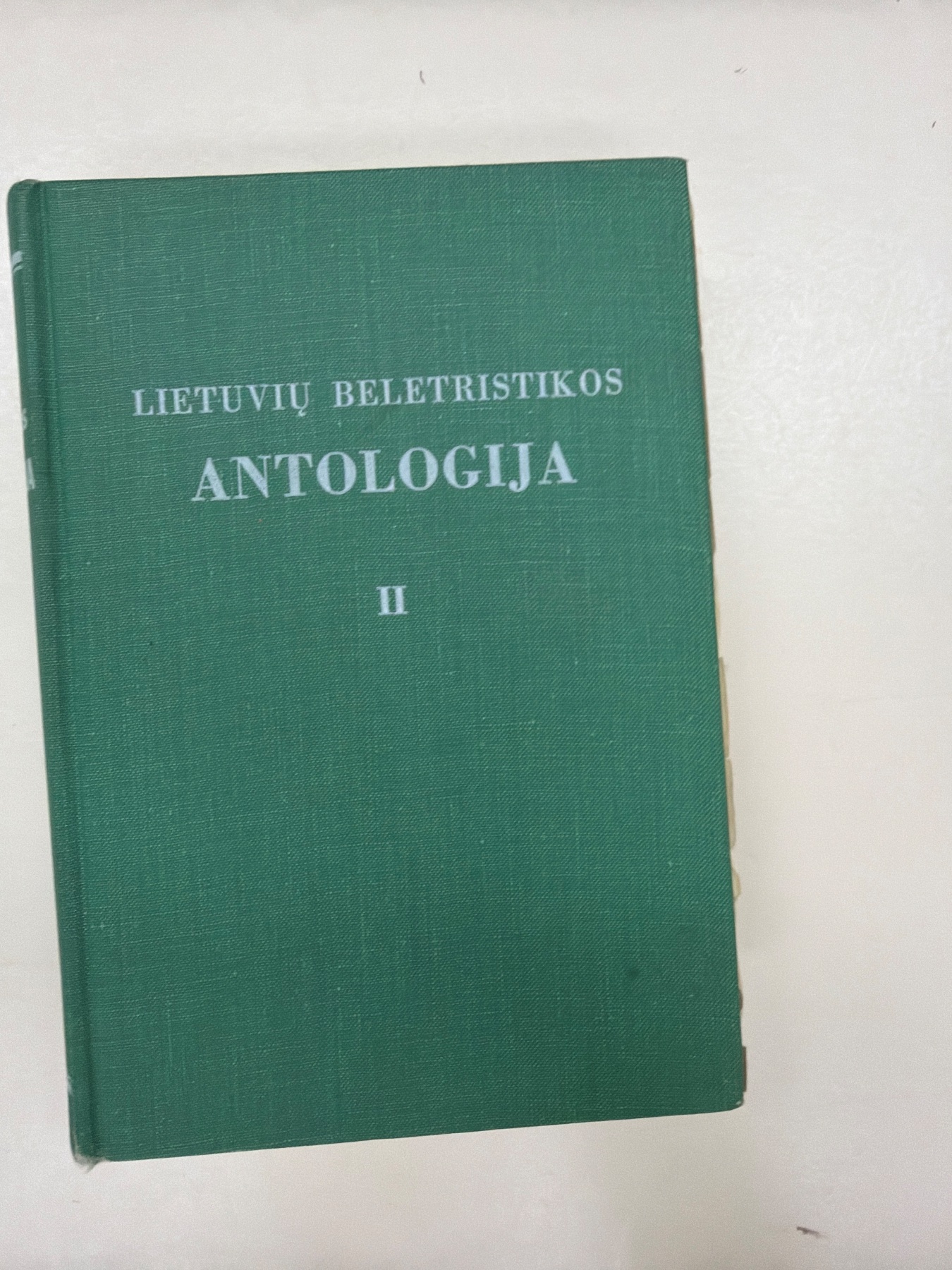
Lietuvių Beletristikos Antologija II
Redagavo Bernardas Brazdžionis ir Benys Babrauskas
1965
Introduction
This is the second volume of the Lithuanian Belles-Lettres Anthology (Lietuvių Beletristikos Antologija), edited by poet Bernardas Brazdžionis and critic Benys Babrauskas and published in Chicago in 1965 by the Lithuanian Book Club. A landmark diaspora literary compilation, it gathers prose fiction from Lithuanian writers active during the interwar independence period and in exile, preserving a literary tradition under conditions of Soviet occupation of the homeland. The anthology stands as a deliberate act of cultural memory, collecting and transmitting Lithuanian narrative prose across generations of diaspora readers.
Community and publication context
Community and publication setting
Context and significance
Significance
The Lietuvių Beletristikos Antologija II represents one of the most ambitious Lithuanian literary publishing projects of the diaspora era. Edited by Bernardas Brazdžionis — himself one of the most celebrated Lithuanian poets of the twentieth century — and Benys Babrauskas, the anthology gathers the prose achievements of a generation of Lithuanian writers whose work flourished during the brief but culturally rich period of Lithuanian independence (1918–1940). Published in Chicago in 1965, two decades into Soviet occupation of Lithuania, the volume functions simultaneously as a literary canon, a cultural archive, and an act of resistance against the Soviet rewriting of Lithuanian literary history described explicitly in the editors' foreword.
For Lithuanian-Americans and the broader diaspora, this anthology was a primary means of accessing the literary heritage of the homeland in a form free from Soviet censorship or ideological distortion. The bio-bibliographic author profiles, with photographs, personalized the literary tradition for readers who may never have met these writers or visited Lithuania. The fiction itself — spanning rural Lithuanian village life, the immigrant experience in America, and the landscapes of interwar Lithuania — offered diaspora readers both an anchor to inherited cultural identity and a window onto the world their parents and grandparents had left behind. As a document of diaspora cultural institution-building, the volume attests to the remarkable organizational capacity of the Chicago Lithuanian community and the central role of the Lithuanian Book Club and Draugas press in sustaining a living Lithuanian literary public sphere far from the homeland.
How this record carried memory
Deliberate diaspora literary canon formation; the editors explicitly frame the anthology as preserving and transmitting Lithuanian belles-lettres from the independence era in the absence of free literary production in Soviet-occupied Lithuania. Published by the Lithuanian Book Club (Lietuviškos Knygos Klubas) and printed at the Draugas press in Chicago, both central institutions of the North American Lithuanian diaspora cultural infrastructure.
Record connections
People, places, and institutions linked in the catalog