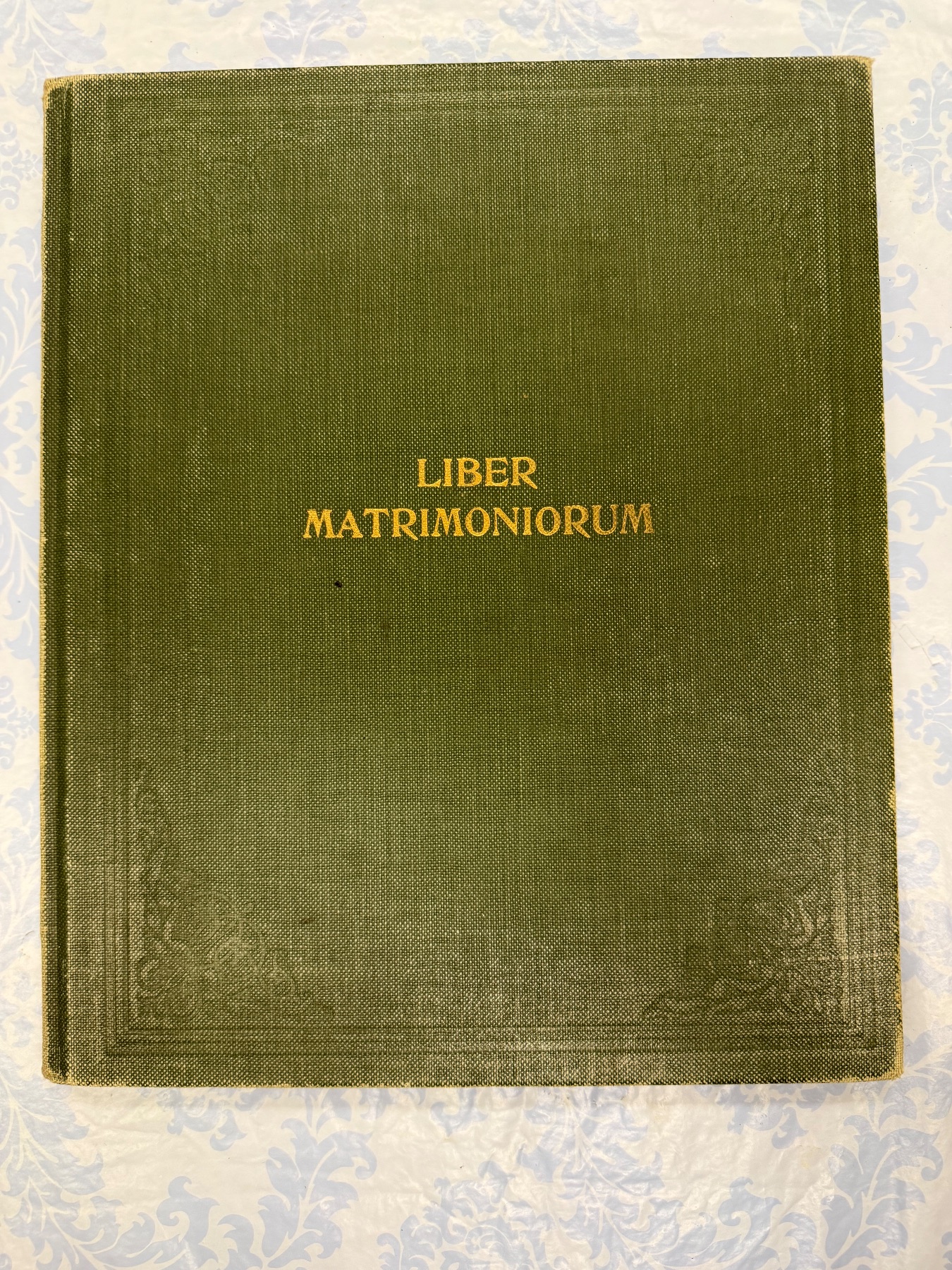
Liber Matrimoniorum
1940
Introduction
This Liber Matrimoniorum is a Roman Catholic parish marriage register printed in 1940 by B. Herder Book Co. of St. Louis and filled with handwritten entries spanning at least the 1940s through the 1960s-2000s, recording the marriages of Lithuanian-American and mixed-background parishioners. The register captures decades of sacramental life in a Lithuanian diaspora parish community, preserving the names, parentage, baptismal origins, witnesses, and officiating priests for each union. As a primary genealogical and community-history document, it is irreplaceable evidence of Lithuanian immigrant family networks and their integration into American Catholic parish life.
Community and publication context
Community and publication setting
Context and significance
Significance
This Liber Matrimoniorum represents a decades-long institutional record of marriage within a Lithuanian-American Roman Catholic parish community, spanning from at least 1943 into the early 2000s. It captures the sacramental and social fabric of a diaspora community that maintained religious and ethnic identity through parish life even as immigrant generations gave way to American-born descendants. The interplay of Lithuanian surnames alongside non-Lithuanian names across the register's pages documents both the cohesion of the Lithuanian-American Catholic community and the inevitable processes of assimilation and intermarriage that shaped diaspora identity over time.
As a genealogical resource, the register is of exceptional value: each entry records the names of both spouses, their parents, baptismal parishes and dates, witnesses, officiating ministers, and canonical dispensations. This density of linked family data allows reconstruction of family networks across parishes and even across continents, connecting Detroit-area Lithuanian families to Lithuanian parishes in Lithuania, other American cities, and the DP camp period. The register thus serves simultaneously as a liturgical document, a community membership roll, and a primary source for the social history of Lithuanian-Americans in the mid-to-late twentieth century.
How this record carried memory
Institutional parish record-keeping within a Lithuanian-American Roman Catholic parish. The register preserves Lithuanian surnames, family lineages, and sacramental community membership across multiple generations of diaspora life, functioning as both a canonical document and an inadvertent archive of ethnic community continuity.
Record connections
People, places, and institutions linked in the catalog