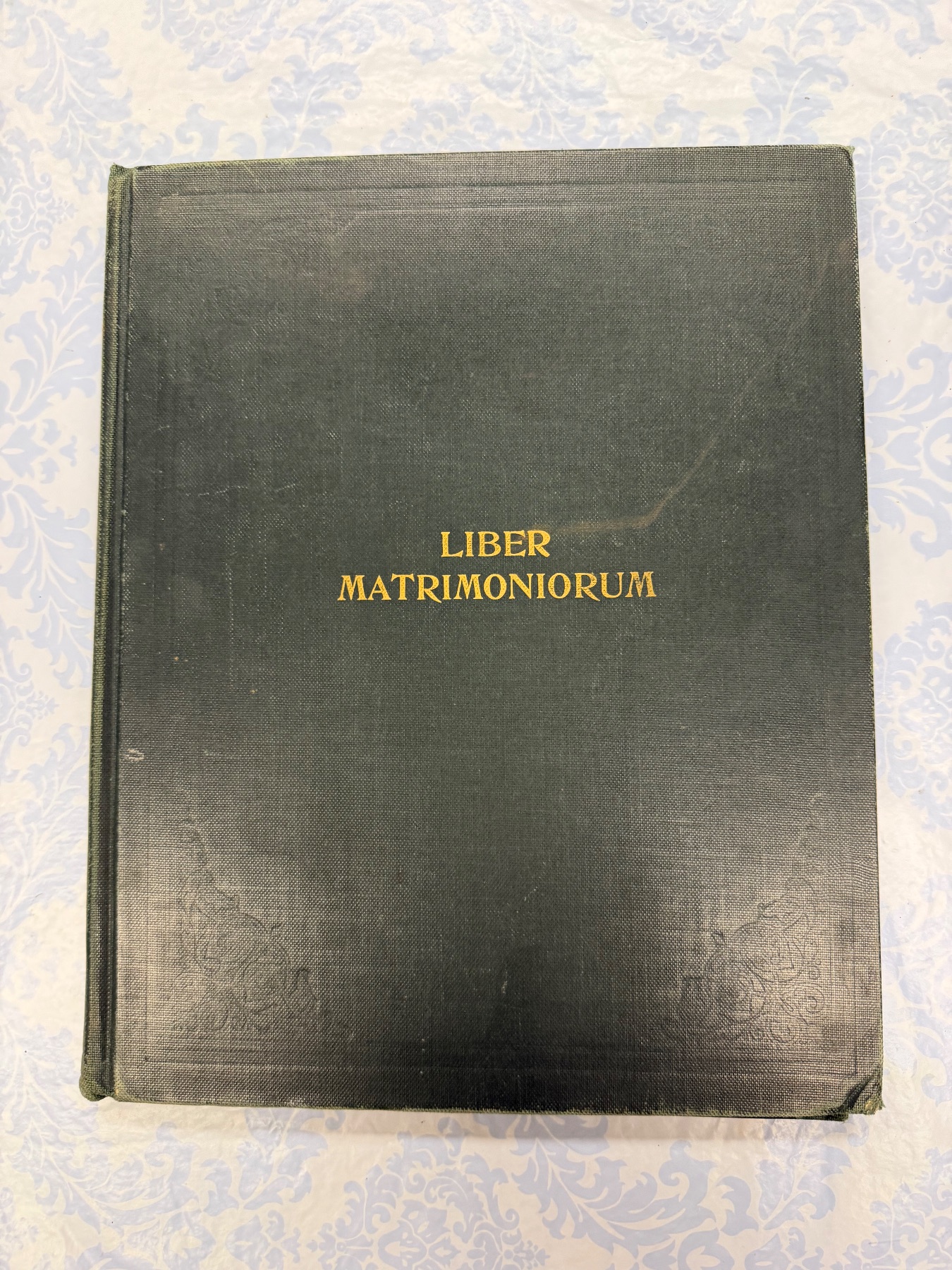
Liber Matrimoniorum
1920 (printed); Jan. 16, 1921 – June 10, 1943 (used)
Introduction
This Liber Matrimoniorum is a Catholic parish marriage register used at St. Anthony's Church in Detroit from January 16, 1921 through June 10, 1943. Printed by B. Herder Book Co. of St. Louis in 1920 and completed in handwritten Latin entries, it documents over two decades of sacramental marriages within Detroit's Lithuanian immigrant community. The register is an irreplaceable primary source for genealogical research, Lithuanian-American family history, and the social history of a major urban ethnic parish during the interwar period.
Community and publication context
Community and publication setting
Context and significance
Significance
This Liber Matrimoniorum is one of the most genealogically dense artifact types that can survive from a Lithuanian-American immigrant parish. Each entry links two families across two generations: the contracting couple, their parents, their respective parishes of baptism (often in Lithuania), and the witnesses — creating a web of kinship, migration, and community ties spanning the Atlantic. For researchers tracing Lithuanian diaspora families through the critical 1921–1943 period — encompassing the mass immigration closure of 1924, the Depression, and the approach of World War II — this register provides data unobtainable from any other source.
The register also documents the assimilation pressures on Lithuanian identity in real time: surnames appear in Lithuanian form, Latinized form, anglicized spelling, and hybrid variants within the same pages. The consistent designation 'Ecclesiae Sti Antonii Lithuanae' asserts ethnic identity as an institutional fact even as individual names shift toward American forms. As a canonical record held outside its originating parish, the register raises important questions of provenance and custody that the archive should investigate; contact with the Archdiocese of Detroit or successor parish records may clarify transfer circumstances and whether a duplicate or complementary register survives.
How this record carried memory
Institutional parish record-keeping within an ethnic Lithuanian Catholic parish in Detroit; the register functioned as both a canonical legal document and a community memory anchor for Lithuanian immigrants and their descendants during the interwar decades.
Record connections
People, places, and institutions linked in the catalog