
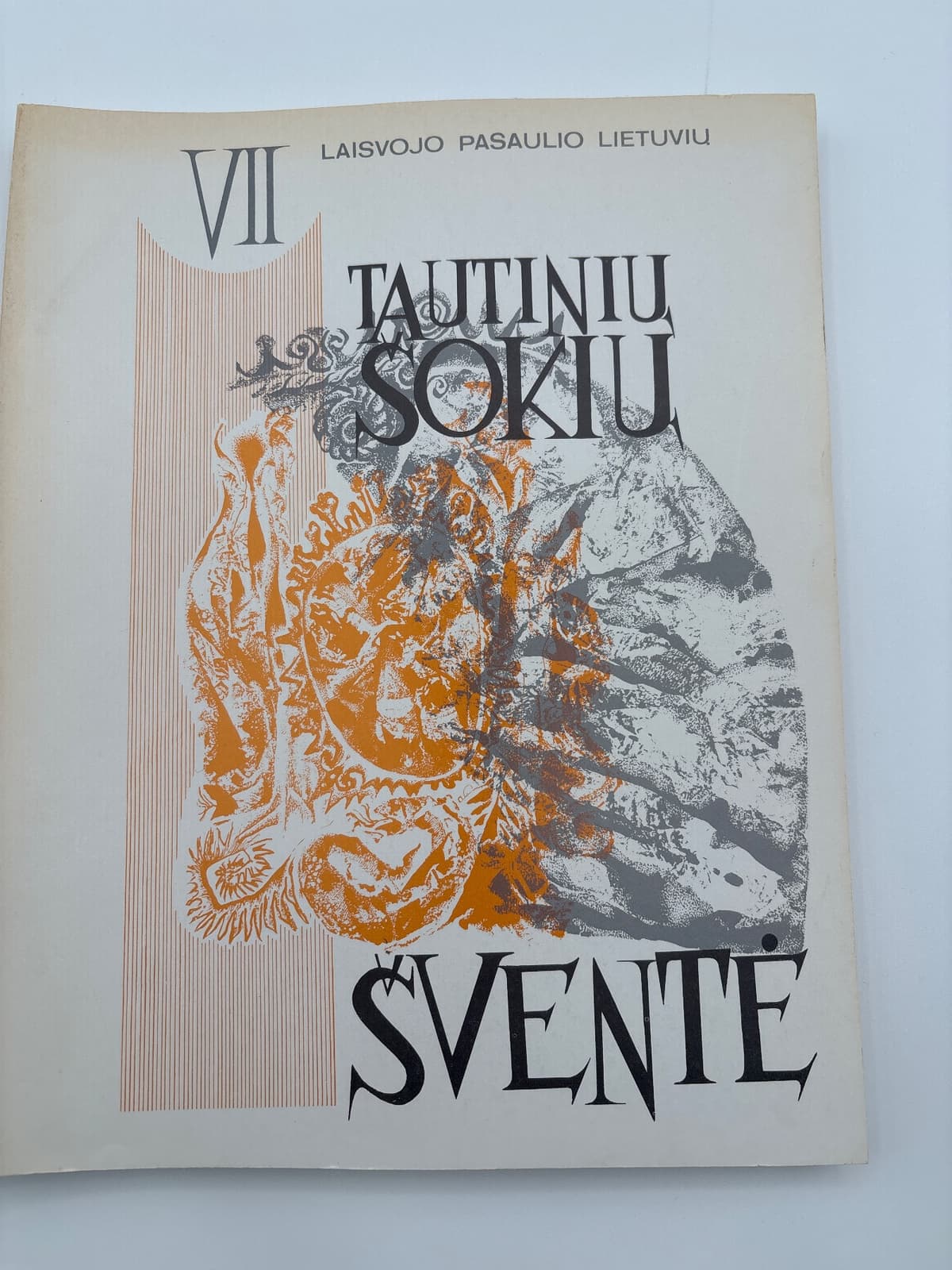
SEPTINTOJI LAISVOJO PASAULIO LIETUVIŲ TAUTINIŲ ŠOKIŲ ŠVENTĖ
As printed in the program
“Laisvojo pasaulio lietuvių kultūros tęstinumas ir tautinės vienybės manifestacija”
This 1984 catalog is distinctive for its overt Cold War framing, with direct political endorsements from U.S. and state officials (Reagan, Celeste) that explicitly link cultural preservation to the struggle for Lithuanian independence. The narrative is unapologetically militant, using metaphors like 'Trojan horse' to describe Soviet influence. The inclusion of a detailed institutional history (L.T.Š. Institute) underscores the diaspora’s disciplined, long-term commitment to cultural survival. The catalog also reveals generational shifts, with second- and third-generation Lithuanian-Americans (e.g., Kansas City ‘Aidas’) participating despite limited language skills, signaling both the festival’s success and its challenges in maintaining linguistic heritage.
— Žiburio Archive, editorial note
How this catalog frames the moment
OccupationThe catalog explicitly frames the festival as a response to Soviet occupation, portraying Lithuanian folk dance as a means of preserving national identity and resisting cultural erasure. The diaspora’s work is positioned as a spiritual and political act in solidarity with the 'suffering homeland.'
Diaspora identityDiaspora identity is defined by cultural continuity, resistance, and eventual return. The catalog emphasizes the diaspora’s role as 'guardians' of Lithuanian culture, tasked with transmitting it to younger generations until Lithuania regains independence.
What is left unsaidThere is no mention of any collaboration or cultural exchange with Soviet Lithuania or its representatives. The catalog pointedly omits any reference to the Lithuanian SSR, reinforcing the narrative of a 'Free World' Lithuanian community in opposition to the occupied homeland.
- Organized by
- JAV ir Kanados Lietuvių Bendruomenės (LB) valdybosLietuvių Tautinių Šokių Institutas
- Pages
- 150-200 (visible page numbers include p. 5, 9, 51, 53, 102, 127, 135; spine thickness and content density suggest 160-190 pages)
Official greetings in this program
“In addition, you can be sure that all Americans support the aspirations of your homeland for freedom, independence, and national self-determination.”
President Reagan commends the festival for promoting Lithuanian culture and contributing to America’s diversity. He explicitly supports Lithuania’s aspirations for freedom, independence, and self-determination.
Source: p. 5“THE STATE OF OHIO IS HONORED TO HOST THIS DISTINCTIVE DANCE COMPANY'S FIRST VISIT TO OUR STATE AND RECOGNIZE THE LITHUANIAN FREE WORLD FOLK DANCERS FOR THEIR CONTRIBUTIONS IN ENHANCING THE CULTURAL VITALITY OF OUR STATE.”
Governor Celeste proclaims July 1, 1984, as 'Lithuanian Free World Folk Dance Day' in Ohio, recognizing the festival’s role in preserving Lithuanian cultural heritage and enhancing the state’s cultural vitality.
Source: p. 10“Though this Festival’s program may have been only a modest attempt, no one saw any flaws, because for everyone the most precious and important thing was the national sentiment, the declaration of Lithuanian unity and love.”
Nors šios Šventės p/ograma buvo pravesta gal tik nedrąsaus bandymo ženkle, bet klaidų mes niekas nematėm, nes visiems buvo pats brangiausias ir svarbiausias dalykas — tautiškas sentimentas, lietuviškos vienybės ir meilės pareiškimas.
Themes articulated by this catalog
- 01The festival is a deliberate act of cultural resistance, preserving Lithuanian identity under occupation by transmitting folk dances, music, and traditions to diaspora youth.
- 02Lithuanian folk dance is framed as a 'spiritual treasury' that embodies the nation’s character, history, and resilience, serving as a bridge between the diaspora and the occupied homeland.
- 03The festival’s primary audience is not just the diaspora but also the broader American public, aiming to showcase Lithuanian creativity and enrich American multicultural life.
- 04The continuity of Lithuanian culture depends on disciplined institutional effort—through the Lithuanian Folk Dance Institute—to train new generations of leaders and safeguard authenticity against ideological dilution.
- 05The festival is a manifestation of 'national unity,' uniting Lithuanians across generations and geographies in a shared commitment to eventual liberation and independence.
Named in this catalog · 9
More forthcoming as full-catalog transcription completes
- Dr. Antanas Butkus · JAV LB Krašto valdybos ir Septintosios tautinių šokių šventės komiteto pirmininkas
- Jadvyga Rutkauskaitė-Reginienė · Šventės šokių direktorė
- Galina Gobienė · Lietuvių Tautinių Šokių Instituto pirmininkė
- Algis Modestas · Muzikos direktorius
- Bronius Kazėnas · Jungtinio choro direktorius
- Vytautas Staškus · Šventės leidinio administratorius
- Alfonsas Nakas · Šventės leidinio redaktorius
- Eglė Giedraitytė-Laniauskienė · Vadovė, Cleveland 'Aitvaras' šokių grupė
- Anita M. Strumillo · Vadovė, Kansas City 'Aidas' šokių grupė
Ensembles · 2
More forthcoming as full-catalog transcription completes
- Aitvaras · Cleveland, USA
- Aidas · Kansas City, USA