
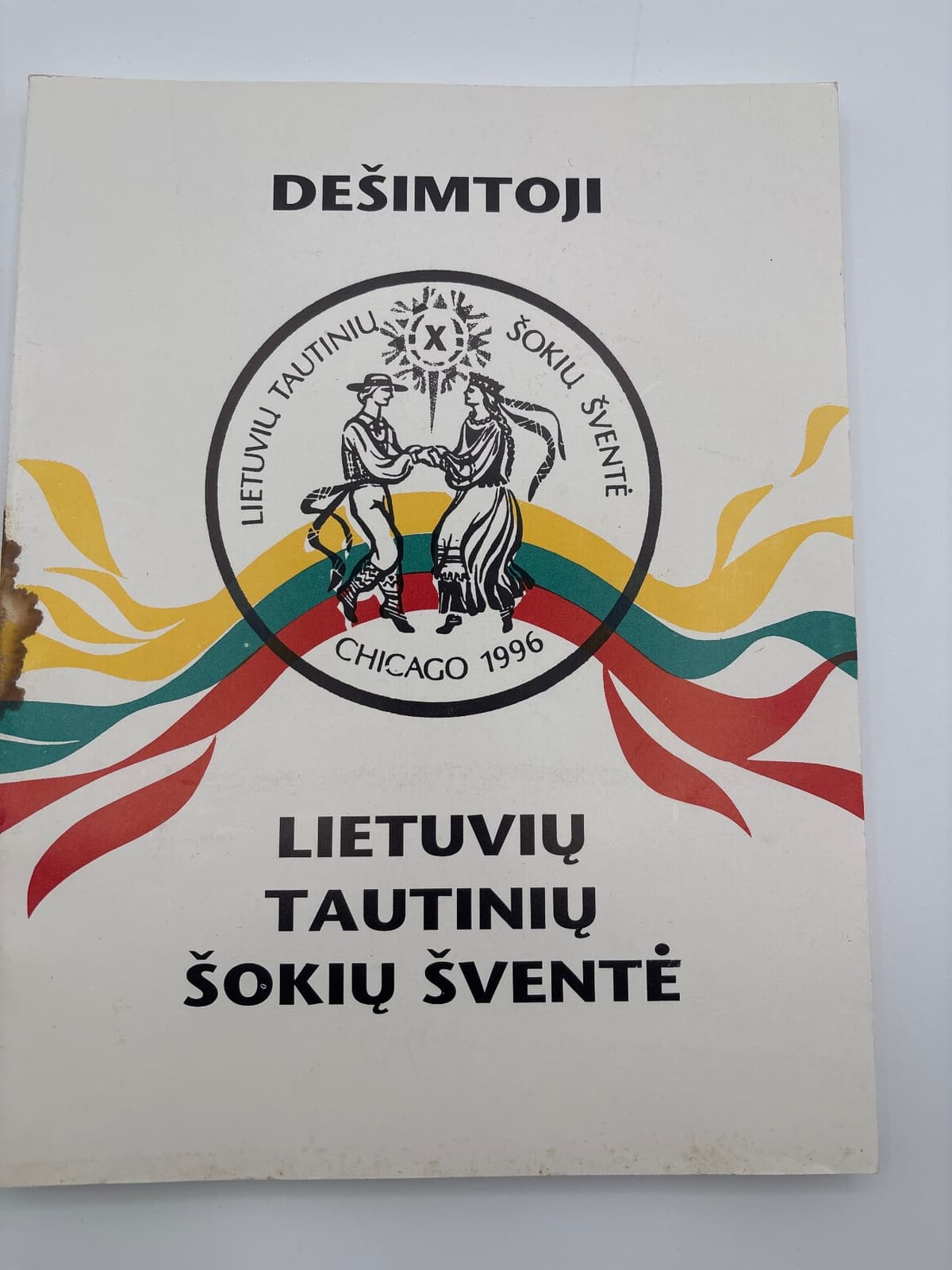
X DEŠIMTOJI LIETUVIŲ TAUTINIŲ ŠOKIŲ ŠVENTĖ
As printed in the program
This 1996 catalog is distinctive for its explicit positioning of the folk dance festival as both a cultural and political act, occurring just six years after Lithuania's restoration of independence. The catalog's essays and greetings frame the event as a celebration of resilience, with the diaspora's role in preserving Lithuanian identity during Soviet occupation taking center stage. The inclusion of a message from the President of Lithuania underscores the festival's significance as a symbol of national unity and continuity. The catalog also highlights the generational transmission of tradition, with veterans and youth participating side by side, reflecting the diaspora's long-term commitment to cultural preservation.
— Žiburio Archive, editorial note
How this catalog frames the moment
OccupationThe catalog explicitly frames the festival as an act of resistance and cultural defiance against Soviet occupation. It positions the diaspora's preservation of folk dance and traditions as a means of sustaining Lithuanian national identity and the dream of independence during decades of occupation.
Diaspora identityThe diaspora is framed as an integral part of the Lithuanian nation, with the catalog emphasizing the continuity of cultural practices as a way to maintain a unified national identity. The Lithuanian Community (Lietuvių Bendruomenė) is portrayed as the institutional backbone of this effort, uniting Lithuanians across generations and geographies.
What is left unsaidThe catalog does not mention any Soviet or post-Soviet Lithuanian government involvement in the festival's organization, despite Lithuania's independence being restored in 1990. There is also no direct critique of the Soviet regime by name, though the subtext of cultural preservation as resistance is clear. Additionally, the catalog avoids explicit discussion of political divisions within the diaspora, focusing instead on unity.
- Organized by
- JAV ir KANADOS LIETUVIŲ BENDRUOMENĖSLIETUVIŲ TAUTINIŲ ŠOKIŲ INSTITUTAS
- Pages
- 40
Official greetings in this program
“Iš visos širdies sveikinu jus dešimtosios lietuvių tautinių šokių šventės proga. Iš savo protėvių amžiams esame paveldėję karštą meilę savo tėvynei, tautos papročiams, tradicijoms, lietuviškai dainai ir šokiui.”
I wholeheartedly congratulate you on the occasion of the tenth Lithuanian folk dance festival. From our ancestors, we have inherited a fervent love for our homeland, our nation's customs, traditions, Lithuanian song, and dance.
Source: p. 17“Dalyvaudami šioje Šventėje, Jūs jungiatės į patį gražiausią lietuviškosios kultūros reiškinį -- tautinį šokį. Jūs užtikrinat tautinių šokių švenčių tęstinumą, gyvastingumą ir reikšmingumą šioje Atlanto pusėje.”
By participating in this Festival, you join the most beautiful manifestation of Lithuanian culture—the folk dance. You ensure the continuity, vitality, and significance of folk dance festivals on this side of the Atlantic.
Source: p. 3“I greet the noble, Lithuanian movement, inspired and ignited by the power of beauty, born in the depths, awakened in the sun, rising like the high wave of the Baltic...”
Sveikinu taurų, lietuvišką judesį Ikvėptą, uždegtą grožio jėga, Gelmėse gimusį, saulėj pabudusį, Kylantį Baltijos aukšta banga...
Themes articulated by this catalog
- 01The festival is a celebration of Lithuanian national identity and cultural resilience, particularly in the diaspora, serving as a living link to the homeland and its traditions.
- 02Folk dance is framed as a communal act of cultural preservation, where participants—regardless of geographic origin—unite through shared movement, music, and language to sustain Lithuanian heritage.
- 03The catalog positions the festival as a testament to the diaspora's role in maintaining Lithuanian statehood ideals during Soviet occupation, emphasizing continuity and defiance through cultural expression.
- 04The event is presented as a bridge between generations, where veterans and youth alike participate, ensuring the transmission of traditions and the vitality of Lithuanian identity abroad.
- 05The festival is explicitly tied to the political project of Lithuanian independence, with the catalog arguing that cultural festivals like this one helped sustain the dream of sovereignty and fostered global solidarity.
Named in this catalog · 26
More forthcoming as full-catalog transcription completes
- Violeta Smieliauskaitė-Fabianovich · Vyr. Meno Vadovė (Artistic Director)
- J. Augustaitytė-Vaičiūnienė · Poet (opening poem)
- Dalia Bilaišytė · Vyriausios asistentė (Assistant to Artistic Director)
- Rėda Ardytė-Pliūrienė · Vyriausios asistentė (Assistant to Artistic Director)
- Lionė Bradūnaitė-Kazlauskienė · Vyriausios asistentė (Assistant to Artistic Director)
- Audra Aleknaitė-Lintakienė · Vyriausios asistentė (Assistant to Artistic Director)
- Anatolijus Lapinskas · Kompozitorius (Composer)
- Darius Polikaitis · Šventės šokių muzikinių įrašų vadovas, Muzikos patarėjas Amerikoje (Music Director, Music Advisor in America)
- Audra Budrytė · Programos vedėja (Program Host)
- Arvydas Barzdukas · Essayist ("Lietuvių Bendruomenė: Išlikti ir Išlaikyti")
- Juozas Lingys · Choreographer
- Marija Baronaitė-Grėbliūnienė · Choreographer
- Aldona Rugytė-Bulotienė · Choreographer
- Nijolė Jasėnaitė-Pupienė · Choreographer
- Ona Pivoriūnaitė-Ivaškienė · Choreographer
- Ona Razutienė · Choreographer
- Kotryna Marijošienė · Choreographer
- Aldona Masėnienė · Choreographer
- Snieguolė Einikytė · Choreographer, Lietuvos liaudies kultūros centro choreografijos lektorė (Choreography Lecturer at Lithuanian Folk Culture Centre)
- Jadvygą Reginienė · Choreographer (description author)
- Irena Narbutaitė-Smieliauskienė · Choreographer
- Genovaitė Dumčiūtė-Breichmanienė · Choreographer
- Jadvygą Meiliūnaitė-Matulaitienė · Choreographer
- Elena Morkūnienė · Choreographer
- Ričardas Tamutis · Choreographer
- Juzė Augustaitytė-Vaičiūnienė · Choreographer
Ensembles · 9
More forthcoming as full-catalog transcription completes
- Panevėžio šokių ansamblis "Grandinėlė" · Panevėžys, Lithuania
- Klaipėdos ansamblis "Vėtrungė" · Klaipėda, Lithuania
- ansamblis "Lietuva" · Vilnius, Lithuania
- Vilniaus J. Tallat-Kelpšos konservatorijos choras · Vilnius, Lithuania
- Vilniaus Karoliniškių muzikos mokykla · Vilnius, Lithuania
- Lietuvos Filharmonijos kapela · Vilnius, Lithuania
- Lietuvos radijo orkestras · Vilnius, Lithuania
- Alytaus "Dainavos" ansamblis · Alytus, Lithuania
- Vilniaus tradicinės ir Katalikiškosios etnografijos ansamblis "Ūla" · Vilnius, Lithuania