Lietuvių Beletristikos Antologija II
Bernardas Brazdžionis ir Benediktas Babrauskas
1965
Historical and community context
Where this record belongs
Diaspora freedom
Introduction
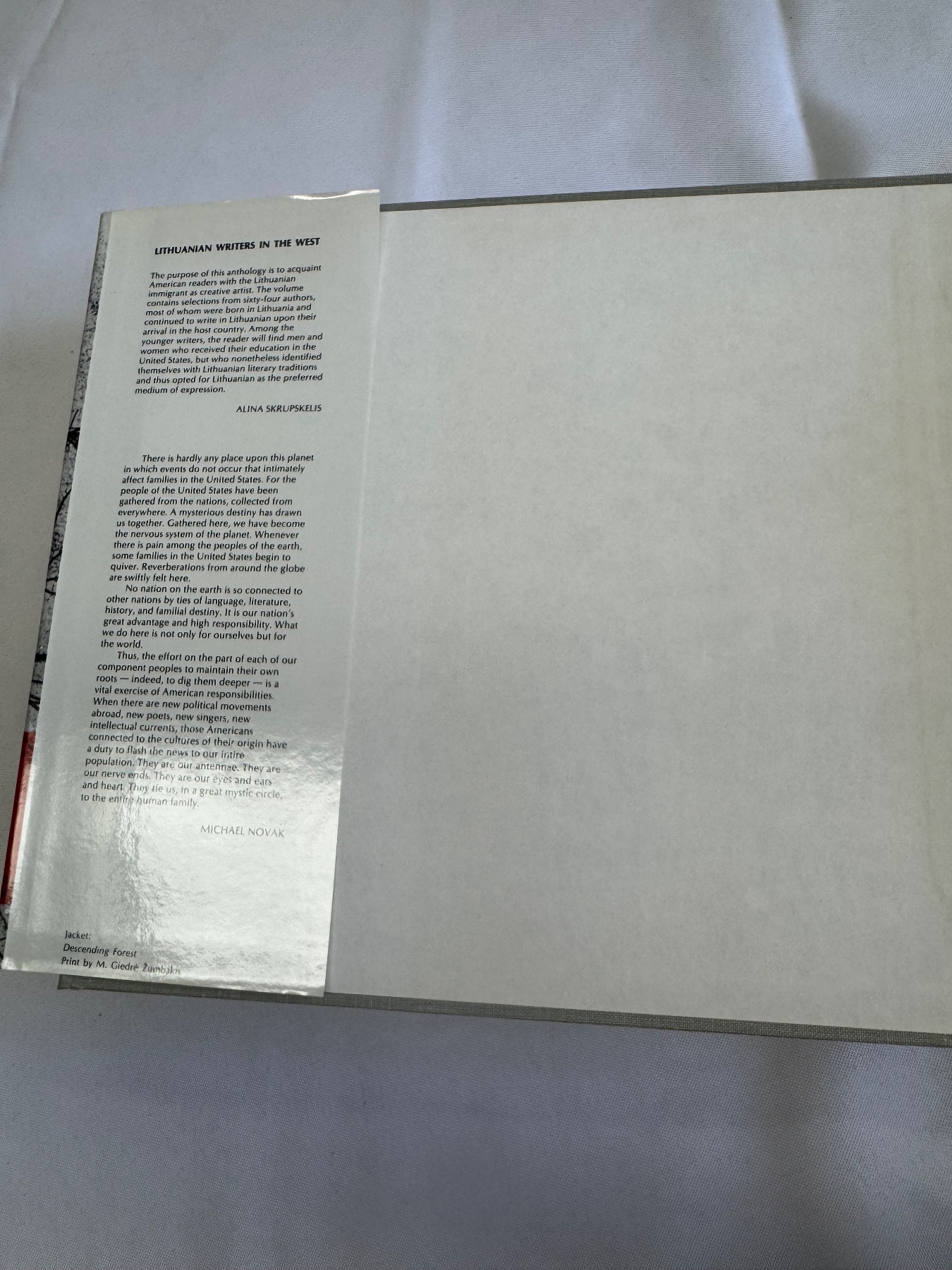
This is the second volume of a landmark Lithuanian fiction anthology compiled in diaspora Chicago in 1965, gathering dozens of Lithuanian prose writers spanning the interwar and exile generations into a single canonical collection. Edited by two major figures of Lithuanian diaspora letters — poet Bernardas Brazdžionis and writer Benediktas Babrauskas — it represents the most ambitious effort of the Lietuviškos Knygos Klubas to codify Lithuanian literary heritage in exile. The anthology preserves the voices of writers who could not publish freely under Soviet occupation, making it an irreplaceable record of mid-20th century Lithuanian prose.
Context and significance
Significance
This anthology represents one of the most significant institutional acts of Lithuanian diaspora cultural infrastructure: the deliberate canonization of Lithuanian prose literature outside Soviet control. The Lietuviškos Knygos Klubas — the Lithuanian Book Club — functioned as a subscription-based publishing cooperative that enabled diaspora Lithuanians in America to sustain a Lithuanian-language print culture without state subsidy or Soviet censorship. By commissioning editors of the stature of Bernardas Brazdžionis (perhaps the most celebrated diaspora poet) and Benediktas Babrauskas, the organization signaled that diaspora literary culture was not merely survival reading but constituted a genuine, self-conscious literary tradition.
The anthology's breadth — spanning from established interwar writers like Kazys Boruta to exile generation authors like Antanas Škėma and Algirdas Landsbergis — reflects a conscious effort to bridge the generational rupture caused by the 1944 Soviet re-occupation and mass exodus. Authors who had fled occupied Lithuania and built new literary careers in DP camps and then in American cities are placed in dialogue with their interwar predecessors, constructing a continuous Lithuanian literary tradition that Soviet cultural authorities could not erase or monopolize. This act of literary continuity was itself a political statement, however implicit.
For diaspora communities and Lithuanian heritage schools, anthologies like this served as the primary vehicle of literary education — the textbook through which the next American-born generation could encounter Lithuanian prose at its most accomplished. The inclusion of P. Jurkus as cover designer (himself a writer and artist contributor) and the printing at Draugas press (the Chicago Lithuanian Catholic daily) embeds the anthology within a dense web of diaspora institutions — press, book club, literary community — that collectively constituted an autonomous Lithuanian cultural sphere in exile.
How this record carried memory
Identity preservation, Continuity statement explicit, Pedagogical framing
Record connections
People, places, and institutions linked in the catalog