Dainavos Šalies Senų Žmonių Padavimai
1948
Historical and community context
Where this record belongs
Allied authorization (DP) — published in the American occupation zone in Schweinfurt, Germany, 1948, under Allied DP camp cultural freedom
Introduction
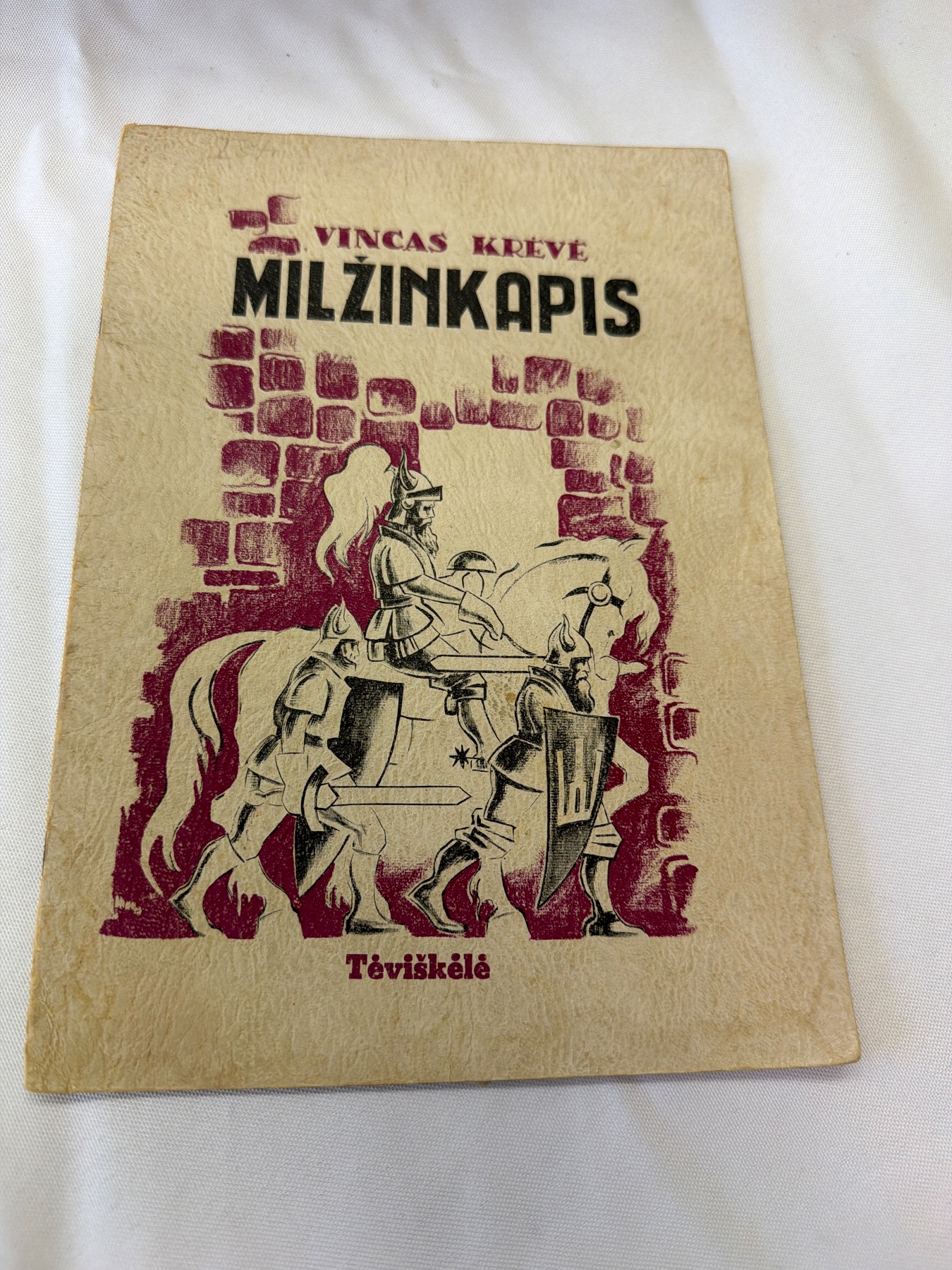
This is the fifth edition of Vincas Krėvė's foundational Lithuanian folklore classic — legends and tales of the Dainava region — published in 1948 in a German DP camp by the Tėviškės press with a print run of 4,000 copies. It represents one of the most iconic Lithuanian cultural texts deliberately chosen for diaspora transmission at the precise moment of national existential crisis. The fact that Lithuanian refugees in Schweinfurt prioritized reprinting this beloved work of literary folklore demonstrates the centrality of pre-Christian mythological heritage to diaspora identity preservation.
Context and significance
Significance
The publication of Dainavos Šalies Senų Žmonių Padavimai as the fifth edition in Schweinfurt in 1948 reveals the extraordinary sophistication of diaspora institutional infrastructure even in the chaos of the immediate postwar DP period. Tėviškės knygų leidykla had the organizational capacity to source an earlier interwar edition, commission a new cover from the distinguished artist V. K. Jonynas (who would go on to become a major figure in American Lithuanian art), arrange printing with a German commercial press, produce 4,000 copies, and distribute them across the DP camp network — all within three years of the end of the war. This was not ad hoc survival printing but deliberate canon-formation: choosing this specific text signals that the diaspora leadership understood cultural reproduction as requiring a mythological foundation, not just religious or political texts.
Krėvė's padavimai occupy a unique position in Lithuanian cultural survival mechanisms precisely because they are secular and pre-Christian in content, yet function as sacred cultural vessels. Where Catholic texts preserved Lithuanian through liturgy and where political texts preserved it through ideology, the Dainava legends preserved it through deep mythological memory — giants, enchanted hills, brave princes, the ancient landscape of southeastern Lithuania. For diaspora communities increasingly distanced from the physical land, these legends performed a crucial function: they made the Lithuanian landscape imaginable, vivid, and emotionally present for children who had never seen it. The text thus served as a geographic and spiritual homeland surrogate.
The inclusion of a scholarly apparatus (J.B.'s critical essay on Krėvė's padavimai, a glossary, and a publisher's afterword) in what is ostensibly a popular folklore edition reveals the diaspora's dual audience strategy: the book had to work simultaneously as children's and family reading, as cultural heritage transmission, and as serious literary-scholarly engagement. This hybrid function — popular accessibility combined with scholarly framing — is characteristic of the best DP-era publishing and explains why this edition, printed in a refugee camp, maintains the quality and intellectual seriousness of the interwar Kaunas original.
How this record carried memory
Identity preservation; Continuity statement explicit; the deliberate republication of Lithuania's most beloved folklore collection as a fifth edition in a DP camp is itself the survival mechanism — by placing pre-Christian mythological heritage at the center of diaspora reading culture, the publishers asserted that Lithuanian identity predates Soviet occupation and will outlast it; the Leidėjų žodis (publisher's word) likely makes this continuity argument explicit
Record connections
People, places, and institutions linked in the catalog