Raštai III: Selected Works, Memoirs
1955
Historical and community context
Where this record belongs
Diaspora freedom
Introduction
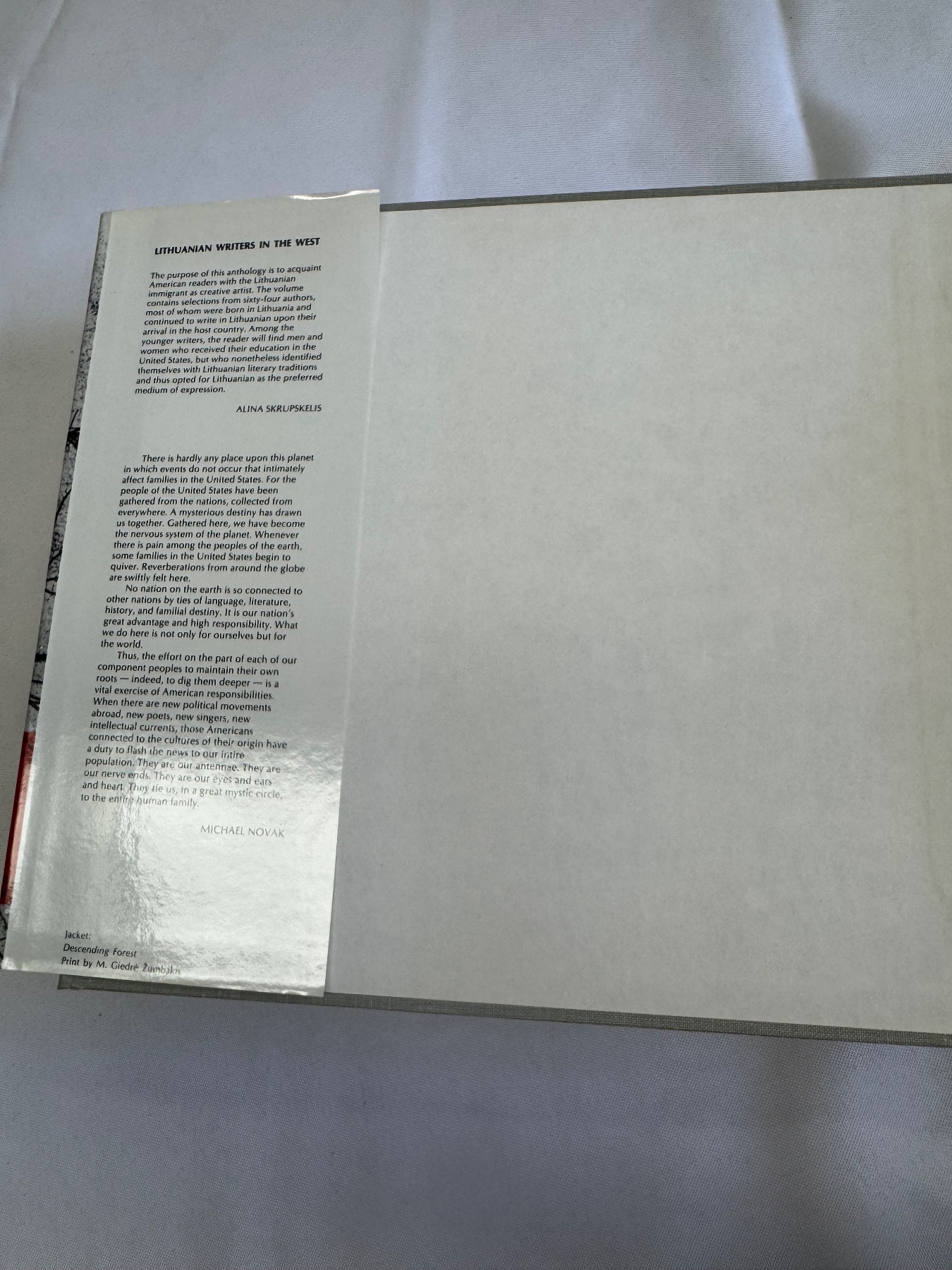
This is the third volume of Juozas Liudžius's collected works, published by the Lithuanian Literary Society of Chicago, combining essays, political-social commentary, and personal memoirs spanning his experiences from the early 20th century through diaspora life. The volume is a rare bilingual-context artifact — printed in Lithuanian for a diaspora audience yet subtitled in English — bridging the literary and intellectual traditions of independent Lithuania with the reality of exile. Its table of contents reveals an extraordinary breadth: from Marxist critique and Lithuanian student life in Moscow (1911–1915) to theological reflections and personal correspondence, making it a singular record of one Lithuanian intellectual's full life arc.
Context and significance
Significance
This volume exemplifies the mature institutional capacity of the Lithuanian-American literary diaspora in the mid-1950s — a moment when exile communities had stabilized sufficiently to produce and distribute multi-volume collected works of significant length. The Lithuanian Literary Society of Chicago functioned as a de facto national press in exile, sustaining a literate public sphere that Soviet-occupied Lithuania could not. That a single author's collected works could reach Volume III, with a formal corrigenda sheet, points to a community that maintained editorial standards and expected readers to engage critically with published texts.
Liudžius's liberal public persona — explicitly controversial within the diaspora, as evidenced by his conflict with 'Kunigų Vienybė' and Prof. V. Stanka — reveals that the diaspora was not a monolithic conservative bloc but an active site of ideological contestation. His willingness to criticize clerical conservatism, engage Marxist theory on its own terms, and write memoirs of his 1911–1915 Moscow student years demonstrates a strand of secular-nationalist Lithuanian intellectualism that is underrepresented in most diaspora archival collections, which skew heavily Catholic and anti-communist.
How this record carried memory
Identity preservation, Continuity statement explicit, Ideology stripped/softened, Pedagogical framing
Record connections
People, places, and institutions linked in the catalog