Trumpa Diena
Historical and community context
Where this record belongs
Diaspora freedom — published in Chicago under full editorial and creative freedom, outside Soviet censorship; the novel's content depicting pre-Soviet Lithuanian village life, including a scene depicting Soviet-era militia recruitment (page 355, 'Tegyvuoja Stalinas!'), demonstrates the author's freedom to critically represent the Soviet occupation period
Context and significance
Significance
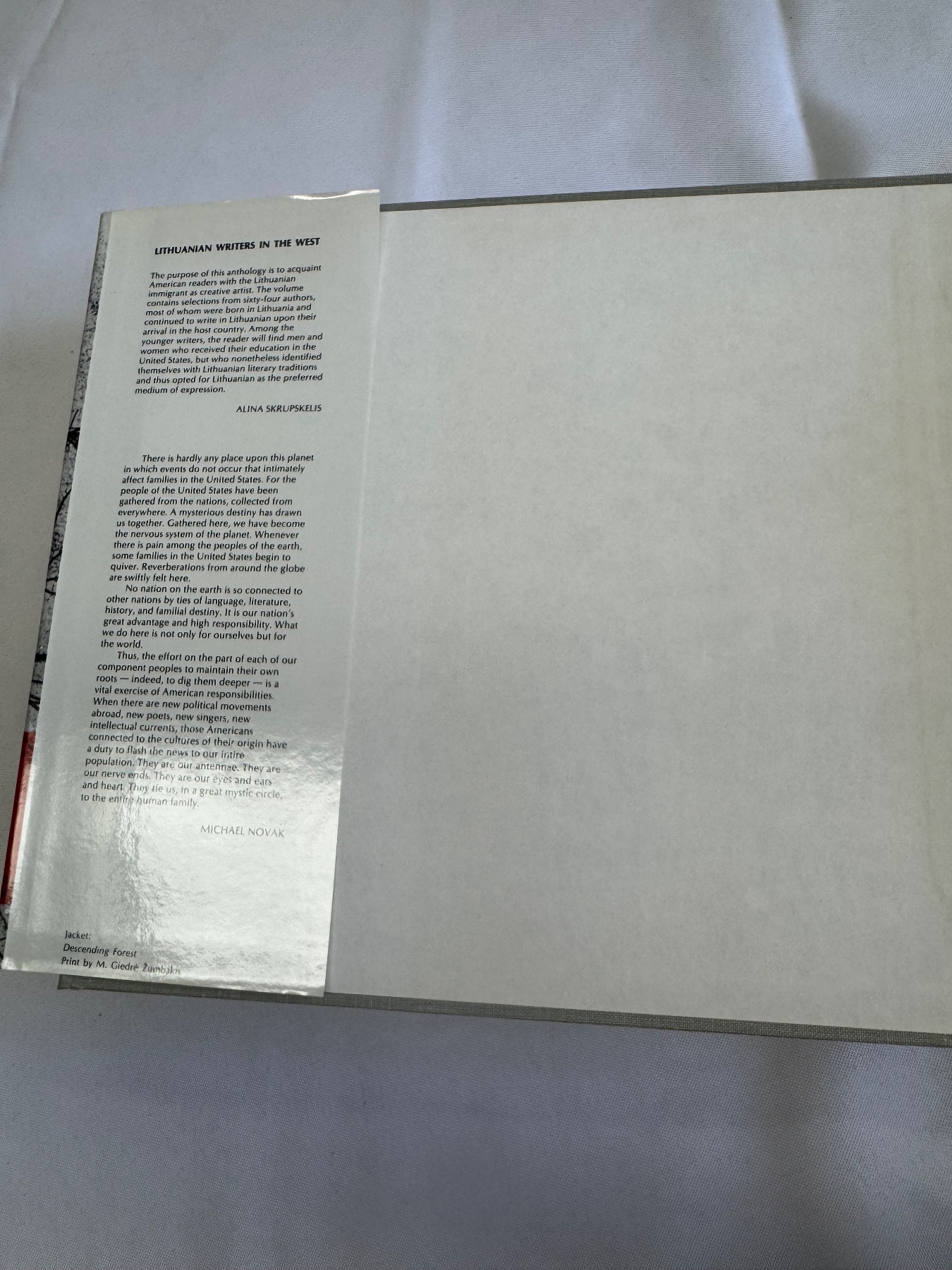
Trumpa Diena exemplifies the most important function of diaspora literary publishing: the creation and distribution of cultural memory in narrative form. The Draugas novel competition, the Lietuviškos Knygos Klubas publication mechanism, and the jury of major diaspora intellectuals (including poet Bernardas Brazdžionis, philosopher Juozas Girnius) represent an entire ecosystem of diaspora cultural infrastructure working in coordinated fashion to produce, validate, and distribute Lithuanian literary culture under conditions of national exile. The prize citation's description of the work as a 'lietuviškos kaimo buities veikalas' (work of Lithuanian rural/village life) signals the community's conscious valuation of this genre as essential cultural preservation.
The novel's cultural survival mechanism is sophisticated and multilayered. By rendering pre-Soviet Lithuanian village life in rich, sensory, colloquially authentic detail, Alė Rūta created what amounts to an ethnographic literary archive — a text that preserves not only plot and character but the full texture of a vanished social world: the rhythms of agricultural labor (linen processing, cattle herding, harvest), the structure of village social life (gegužinės, dancing, courtship), the folk speech patterns of rural Lithuanians, and the precise vocabulary of material culture (tools, textiles, foods, spatial arrangements). This is cultural survival through literary aesthetics rather than explicit ideology.
The novel also demonstrates the diaspora's capacity to process and represent the trauma of Soviet occupation without sanitizing it — the scene on page 355 depicting Soviet militia recruitment, complete with the cry 'Tegyvuoja Stalinas!', shows that diaspora literary freedom enabled direct engagement with the occupation experience that was impossible inside Lithuania. This makes the novel a hybrid text: simultaneously a nostalgic preservation of pre-war rural life and a critical historical document of the occupation period, produced by a community that could speak freely when Lithuanians inside the country could not.
How this record carried memory
Identity preservation; Continuity statement explicit; Pedagogical framing — the novel functions as an act of cultural memory, preserving in literary form the texture of Lithuanian rural life that Soviet occupation was actively destroying and that diaspora generations were losing contact with; the prize competition itself (Draugas Romano Konkursas) was an institutional mechanism for sustaining Lithuanian literary culture in exile
Record connections
People, places, and institutions linked in the catalog