III Tautinių Šokių Šventė
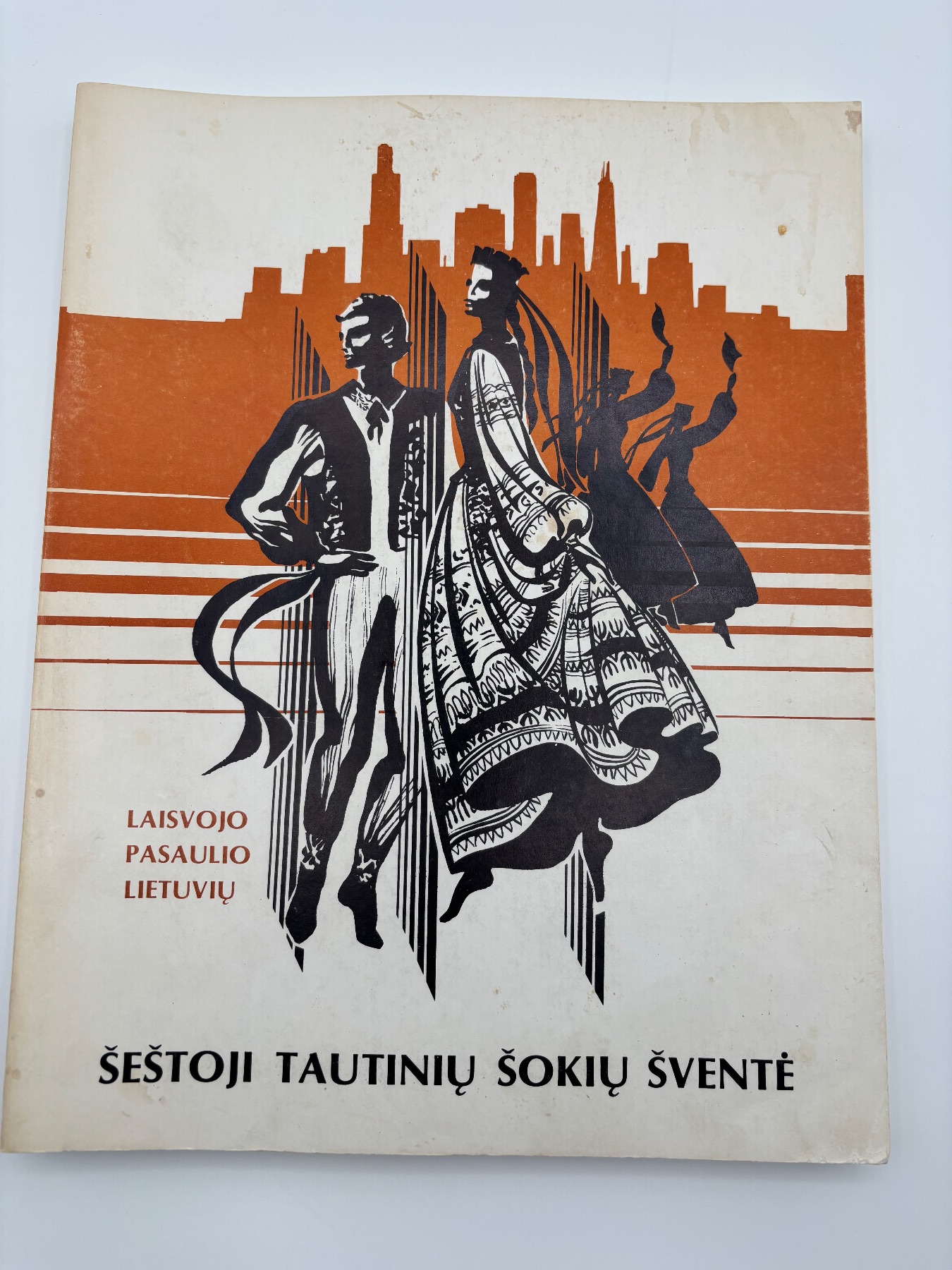
Redagavo Vytautas Radžius; Korektorius: Juozas Slabokas; Spauda: M. Morkūno spaustuvė, Chicago; Viršelis ir leidinio grafika: Telesforas Valius
1968
Historical and community context
Where this record belongs
Diaspora freedom
Introduction
This is the official souvenir program for the Third Lithuanian Folk Dance Festival (III Tautinių Šokių Šventė), held July 7, 1968 at the International Amphitheatre in Chicago — a landmark event commemorating the 50th anniversary of Lithuania's Declaration of Independence. Featuring cover art by master diaspora graphic artist Telesforas Valius, endorsements from U.S. Vice President Hubert H. Humphrey and House Speaker John W. McCormack, and greetings from Lithuanian diplomatic chief Stasys Lozoraitis in Rome, this program documents the apex of organized Lithuanian-American cultural performance life during the Cold War era. It is a rare artifact of diaspora political mobilization, cultural preservation, and transnational identity performance at the highest institutional levels.
Context and significance
Significance
This program book is a primary document of the Lithuanian diaspora's most ambitious cultural performance tradition — the Tautinių Šokių Šventė (Folk Dance Festival) — which served as the single most important vehicle for collective identity expression among North American Lithuanians during the Cold War. The festival infrastructure visible here — a named committee (Trečiosios Tautinių Šokių Šventės Komitetas), professional graphic design by Telesforas Valius, a 60+ page illustrated program, and endorsements from the highest levels of American government — reveals a diaspora community that had, by 1968, achieved remarkable organizational sophistication and political integration without any loss of cultural distinctiveness. The explicit framing of the 1968 festival around the 50th anniversary of Lithuanian independence ('Lietuvos laisvės kovos metai') shows how the diaspora weaponized cultural performance as diplomatic and political advocacy, keeping the question of Soviet-occupied Lithuania alive in American public consciousness.
The document is also a remarkable index of diaspora transnationalism: dance groups from Uruguay (Gintaras), participation lists spanning North and South America, and greetings from Stasys Lozoraitis in Rome (head of the Lithuanian diplomatic service-in-exile) all demonstrate that the Lithuanian diaspora maintained an active transnational network of cultural institutions that transcended any single host country. The Honorary Committee list — including two U.S. Senators, the Governor of Illinois, the Mayor of Chicago, the Speaker of the House, and multiple university presidents — documents the extraordinary civic embeddedness of the Lithuanian-American community and their ability to mobilize American political support for Lithuanian independence precisely through cultural events.
The choice to open the program with a poem by Vytautas Mačernis — a poet who died in 1944 fleeing the Soviet advance, and whose work circulated exclusively in diaspora editions — is a pointed cultural statement: the diaspora positioned itself as the legitimate custodian of Lithuanian literary culture that could not be published freely in Soviet-occupied Lithuania. This program thus operates simultaneously as event documentation, political manifesto, cultural anthology, and community directory.
How this record carried memory
Identity preservation, Continuity statement explicit, Pedagogical framing
Record connections
People, places, and institutions linked in the catalog