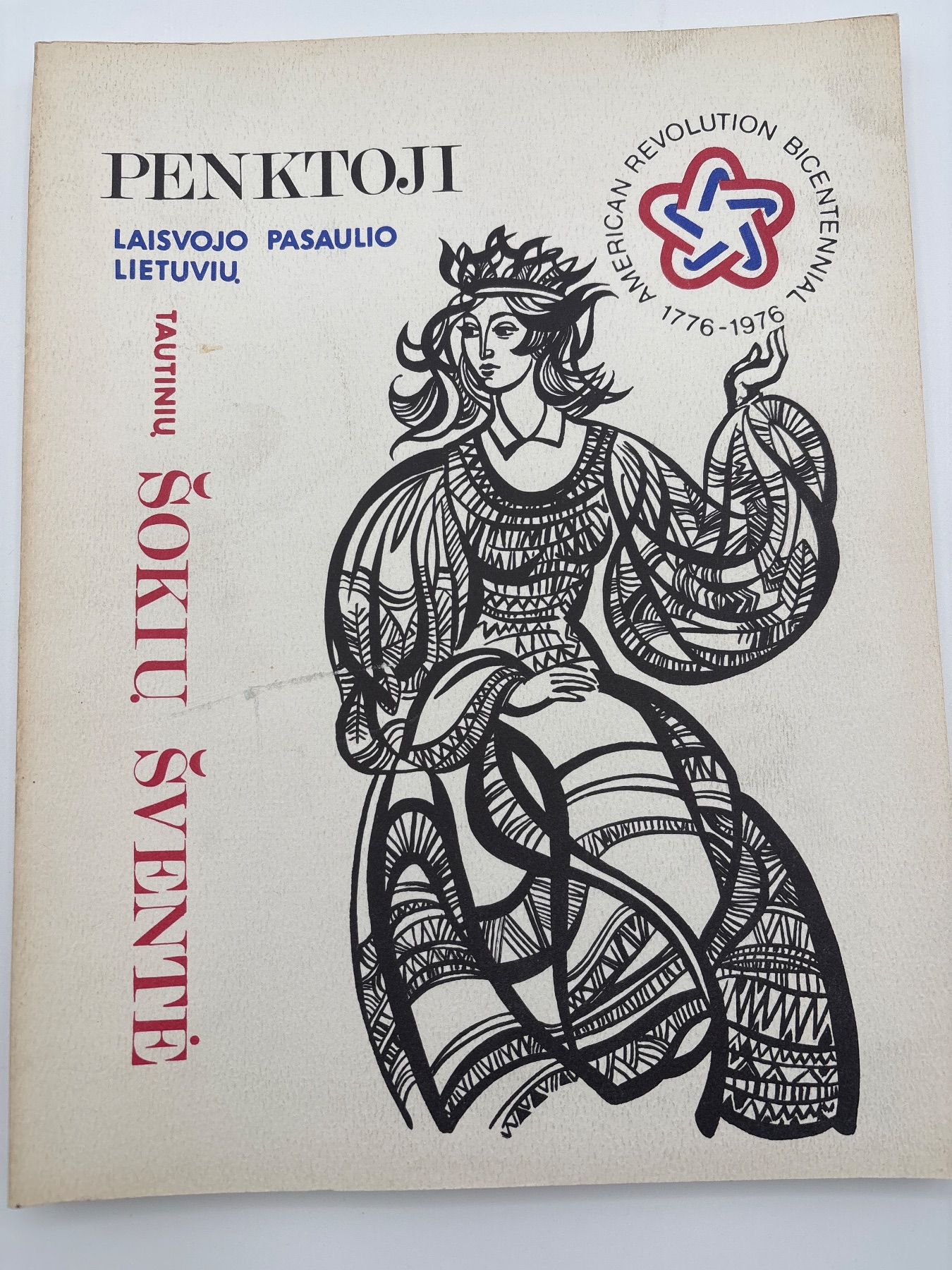
Laisvojo Pasaulio Lietuvių Šeštoji Tautinių Šokių Šventė
Historical and community context
Where this record belongs
Diaspora freedom
Introduction
This 1980 festival program is the official souvenir publication for the Sixth Lithuanian Folk Dance Festival, held at Chicago's International Amphitheatre, gathering over 2,000 dancers from 60 groups worldwide. It documents the peak of Cold War-era Lithuanian diaspora cultural mobilization, when folk dance served explicitly as national resistance — a mass demonstration of Lithuanian survival against Soviet occupation. The program captures an extraordinary network of diaspora institutional infrastructure including U.S. senators, Illinois governors, Lithuanian diplomatic representatives in exile, and Catholic Church hierarchy all united behind a single cultural event.
Context and significance
Significance
This program is a primary document of the Lithuanian diaspora's most sophisticated institutional expression: the recurring Tautinių Šokių Šventė cycle, which served as the diaspora's largest collective ritual. The 1980 edition reveals an organizational infrastructure of remarkable complexity — Lithuanian diplomatic representatives still functioning in five cities across three continents, bipartisan American political support at the highest levels (Speaker of the House, U.S. Senators, multiple Congressmen, Illinois Governor, Chicago Mayor), and a Catholic Church hierarchy that maintained Lithuanian identity as inseparable from spiritual mission. The Honorary Committee list alone documents the full Cold War architecture of Lithuanian exile political legitimacy.
The dance program's ethnographic notes (pages 59, 63) reveal a secondary cultural preservation function: the festival served not just as performance but as the primary mechanism for codifying and transmitting folk dance traditions that had been suppressed or distorted under Soviet occupation in Lithuania itself. Dances like Oželis (from Žemaitija), Rugučiai (from Dzūkų kraštas), and Šustas (from Sūduva/Prūsų borderlands) are documented with their regional origins, historical circumstances of collection, and choreographers — creating an archival record of Lithuanian folk culture maintained outside Soviet influence.
The explicit political framing of the Šventė as 'atsakymas Lietuvos pavergėjams' (an answer to Lithuania's oppressors) and 'Lietuvos laisvinimo kova' (the struggle for Lithuania's liberation) demonstrates how cultural events in the diaspora were never apolitical — they were the primary form of public political resistance available to a stateless people. This publication thus sits at the intersection of folklore preservation, political resistance documentation, and diaspora institutional history, making it essential for understanding how the Lithuanian community maintained sufficient cohesion to contribute to Lithuania's eventual 1990 independence.
How this record carried memory
Identity preservation; Continuity statement explicit; Pedagogical framing; Folk dance as national manifestation ('tautos meno didžioji manifestacija') framed as direct political resistance to Soviet occupation ('atsakymas Lietuvos pavergėjams'). The festival explicitly frames cultural performance as liberation struggle ('Lietuvos laisvinimo kova'), with folk dance serving as the primary vessel for maintaining national identity across the diaspora generation.
Record connections
People, places, and institutions linked in the catalog